
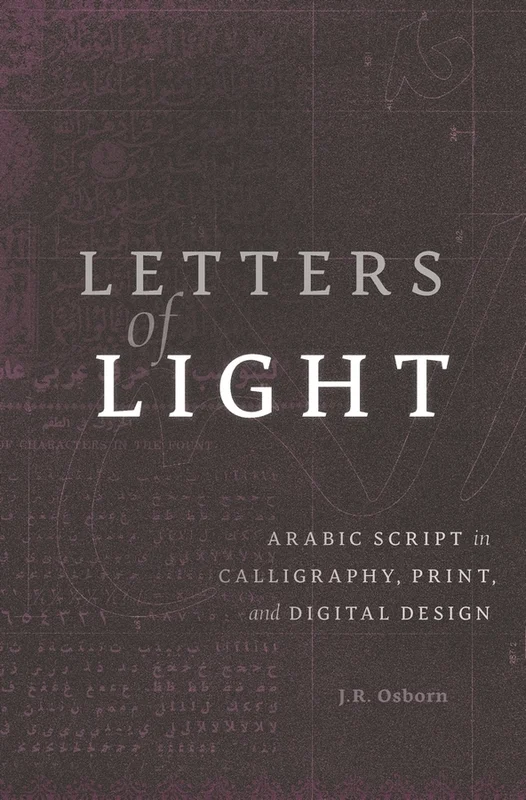
Description
By (author) Osborn J.R.
Short /annotation
Arabic script is one of the world’s most widely used writing systems, for Arabic and non-Arabic languages alike. J. R. Osborn traces its evolution from the earliest inscriptions to digital fonts, from calligraphy to print and beyond. Students of communication, contemporary practitioners, and historians will find this narrative enlightening.
Arabic script remains one of the most widely employed writing systems in the world, for Arabic and non-Arabic languages alike. Focusing on naskh—the style most commonly used across the Middle East—Letters of Light traces the evolution of Arabic script from its earliest inscriptions to digital fonts, from calligraphy to print and beyond. J. R. Osborn narrates this storied past for historians of the Islamic and Arab worlds, for students of communication and technology, and for contemporary practitioners.
The partnership of reed pen and paper during the tenth century inaugurated a golden age of Arabic writing. The shape and proportions of classical calligraphy known as al-khatt al-mansub were formalized, and variations emerged to suit different types of content. The rise of movable type quickly led to European experiments in printing Arabic texts. Ottoman Turkish printers, more sensitive than their European counterparts to the script’s nuances, adopted movable type more cautiously. Debates about “reforming” Arabic script for print technology persisted into the twentieth century.
Arabic script continues to evolve in the digital age. Programmers have adapted it to the international Unicode standard, greatly facilitating Arabic presence online and in word processing. Technology companies are investing considerable resources to facilitate support of Arabic in their products. Professional designers around the world are bringing about a renaissance in the Arabic script community as they reinterpret classical aesthetics and push new boundaries in digital form.
Review quote
“A refreshing and rewarding approach to understanding deeply embedded and cherished cultural values of Islamic lands…Osborn provides important lessons about the Arabic script as a cultural object with a history, grammar, and set of values.”
—
Peter Webb
,
Times Literary Supplement
Review quote
“J. R. Osborn’s Letters of Light is a fascinating investigation of the development of Arabic scripts over the past millennium and their problematic encounter with Western typography, which sliced expressive lines of cursive writing into individual sorts of cold type. Osborn ingeniously explores how the advent of new computer technologies in the twentieth century has opened a promising future for the design of Arabic scripts that conform to and expand upon calligraphy’s formal and aesthetic traditions.”
—
Jonathan M. Bloom, author of Paper Before Print: The History and Impact of Paper in the Islamic World
Review quote
“Letters of Light is an enjoyable and clearly written historical account of the development of the Arabic script, and the Naskh calligraphic style in particular, that elegantly links scribal traditions and conventions to today’s type design discourse. Osborn creates a much-welcome, impartial framework and foundation for further research into Arabic type design and contemporary design tools. This is highly recommended reading for design students, practitioners, and all interested in Arabic typography and Arab visual culture.”
—
Huda Smitshuijzen AbiFarès, The Khatt Foundation, Center for Arabic Typography, Amsterdam
Biographical note
J. R. Osborn is Assistant Professor of Communication, Culture & Technology and Co-Director of the Technology Design Studio at Georgetown University.



Reviews
There are no reviews yet.