
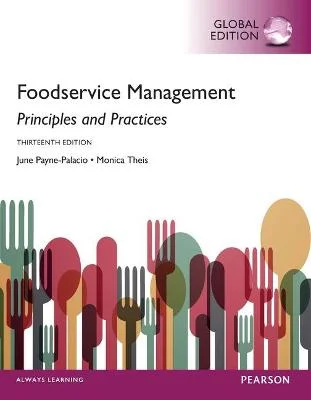
Description
By (author) Payne-Palacio, June, Ph.D., RD; By (author) Theis Monica
For courses in foodservice management or administration; hospitality management; quantity food production and/or purchasing; foodservice accounting/financial management; menu planning; foodservice marketing/merchandising, or related topics. Foodservice Operations for Today’s College Students Authored by leading industry experts with years of teaching experience, the 13th Edition of Foodservice Management: Principles and Practices offers a comprehensive, current, and practical overview of foodservice operations and business principles. Covering topics like food safety, human resources, finance, equipment, design, marketing, and filled with real-life case studies, this text gives college students a deep understanding of the issues they will face in any type of foodservice operation. Rich with graphics and photos, its visually appealing design is organised for maximum student engagement and understanding. This edition has been updated to reflect new trends in sustainability and food safety issues.
Table of contents
Part 1 The Foundations 1 Chapter 1 The Foodservice Industry 3 Chapter 2 The Systems Approach 33 Part 2 The Fundamentals 57 Chapter 3 Food Safety 59 Chapter 4 Facility Sanitation and Safety 93 Chapter 5 The Menu 117 Part 3 The Operational Functions 151 Chapter 6 Purchasing 153 Chapter 7 Receiving, Storage, and Inventory 186 Chapter 8 Production 202 Chapter 9 Service 228 Part 4 The Facilities 249 Chapter 10 Facilities Planning and Design 251 Chapter 11 Equipment and Furnishings 289 Chapter 12 Resource Conservation 313 Part 5 The Management Functions 331 Chapter 13 Organizational Design 333 Chapter 14 Leadership 357 Chapter 15 Human Resource Management 381 Chapter 16 Performance Improvement 411 Chapter 17 Financial Management 437 Chapter 18 Marketing 467 Appendix A Principles of Basic Cooking 483 Appendix B Foodservice Equipment 491 Index 511
Feature
Designed for easy understanding:Logical flow of material is organized to help students build knowledge one key concept at a time, with chapter introductions that link directly to previous chapters, giving students the solid foundation they need to learn each new concept.Extensive use of graphics and photos makes the text more visually interesting and easier to understand, helping students absorb complex concepts more rapidly.Graphics, many created by a leading foodservice design consultant who specializes in college and university foodservice facilities, make the book more visually compelling, and key concepts more intuitively easy to understand.Key terms are boldfaced, with definitions in the margins, so students understand key terms immediately and jargon never becomes an obstacle to understanding.Key concepts are highlighted throughout each chapter, helping readers focus on the most important concepts they need to understand, and review more efficiently.Study and review help:Review questions at the end of each chapter pinpoint key concepts for review, helping students confirm their understanding before moving forward.Critical-Thinking questions challenge students to think conceptually in applying the concepts to real-world situations and promote deeper understanding and synthesis of the material.Real-life examples and authorities:Authored by leading industry experts who work in the industry and teach this content in university settings, giving students confidence that they are receiving accurate, useful information from people who know how to present it exceptionally well.A running case study, based on the actual University of Wisconsin, Madison University Dining Services operation, demonstrates how large-scale campus foodservice operations actually work and provides a strong personal link for college students.



Reviews
There are no reviews yet.